
Are Kids Moving Less Because They’re Less Skilled at Moving?
Sep 19, 2026
We talk a lot about children not getting enough physical activity. More screens, less outdoor play, less incidental movement and less time spent climbing, running, jumping, throwing, catching and simply figuring out what their bodies can do.
Usually the conversation then becomes: how do we get kids moving more? But I think there is another question we need to be asking. What if some children aren’t moving because movement is actually hard for them? Being physically active isn’t only about motivation, opportunity or getting children off screens. Children also need the physical skills and confidence to participate.
Movement skills don’t just appear with age
Running, jumping, hopping, balancing, throwing and catching are known as fundamental movement skills. They form the building blocks for more complex movement, physical activity and sport.
While these skills develop throughout childhood, we shouldn’t assume children will simply acquire them because they get older. A meta-analysis by Logan et al. (2012) found that fundamental movement skills can be significantly improved through targeted motor skill interventions. The authors also highlighted that these skills need to be learned, practised and reinforced rather than being viewed simply as a product of maturation.
This is important when we talk about childhood inactivity, because telling a family their child needs to “move more” may only be part of the answer. We also need to consider whether that child has the skills to participate successfully in movement in the first place.
The link between movement skills and physical activity
This isn’t a new idea. In 2008, Stodden and colleagues proposed a developmental model describing how motor competence, physical activity, perceived competence, physical fitness and weight status may interact as children grow.
The theory was that children who develop greater motor competence may be more likely to participate in physical activity. That participation then provides further opportunities to develop their skills, fitness and confidence. But the opposite pathway may also occur. Children with poorer motor competence may participate less, have fewer opportunities to practise and gradually become less confident in movement. Stodden and colleagues (2008) described these as positive and negative developmental pathways, sometimes referred to as “spirals of engagement” and “disengagement.” It’s important to point out that this was originally a proposed developmental model rather than proof that every child follows this pathway. However, research since then has continued to investigate these relationships. Barnett et al. (2022) reviewed the longitudinal and experimental evidence relating to the model and found strong longitudinal evidence linking childhood motor competence with later health-related fitness, as well as evidence that motor competence predicts subsequent physical activity participation. Interestingly, evidence for the reverse pathway simply participating in more physical activity leading to better motor competence was less consistent. That distinction is really important. Sometimes getting a child to move more may not be enough. We may need to help them become better at moving too.
Robinson et al. (2015) reviewed 82 studies involving more than 20,000 children and adolescents aged 3–17 years. They found a positive association between gross motor competence and physical activity, as well as a strong association between motor competence and health-related fitness. The relationship between motor competence and physical activity also tended to become stronger as children got older.
And when you think about what happens as children grow, that makes sense. At three or four, play can be pretty forgiving. Kids run around, climb, chase each other, throw things and generally have a go. Everyone is still learning. As they get older, movement becomes more organised. Games get faster and more complex. Children are increasingly expected to catch, kick, run, change direction, balance, jump and coordinate their bodies and they also start noticing who can do these things well and who can’t.
Imagine being the child who can’t catch the ball, struggles to keep up with a running game, finds hopping or balancing difficult or can’t quite coordinate a throw.
At five, they may keep trying. By eight or ten, they may already know they’re not very good at it.
So they participate less. When they participate less, they get fewer opportunities to practise and improve. What looks from the outside like a child who “just isn’t sporty” may actually be a child who hasn’t developed some of the underlying movement skills required to feel successful.
So what should children actually be able to do?
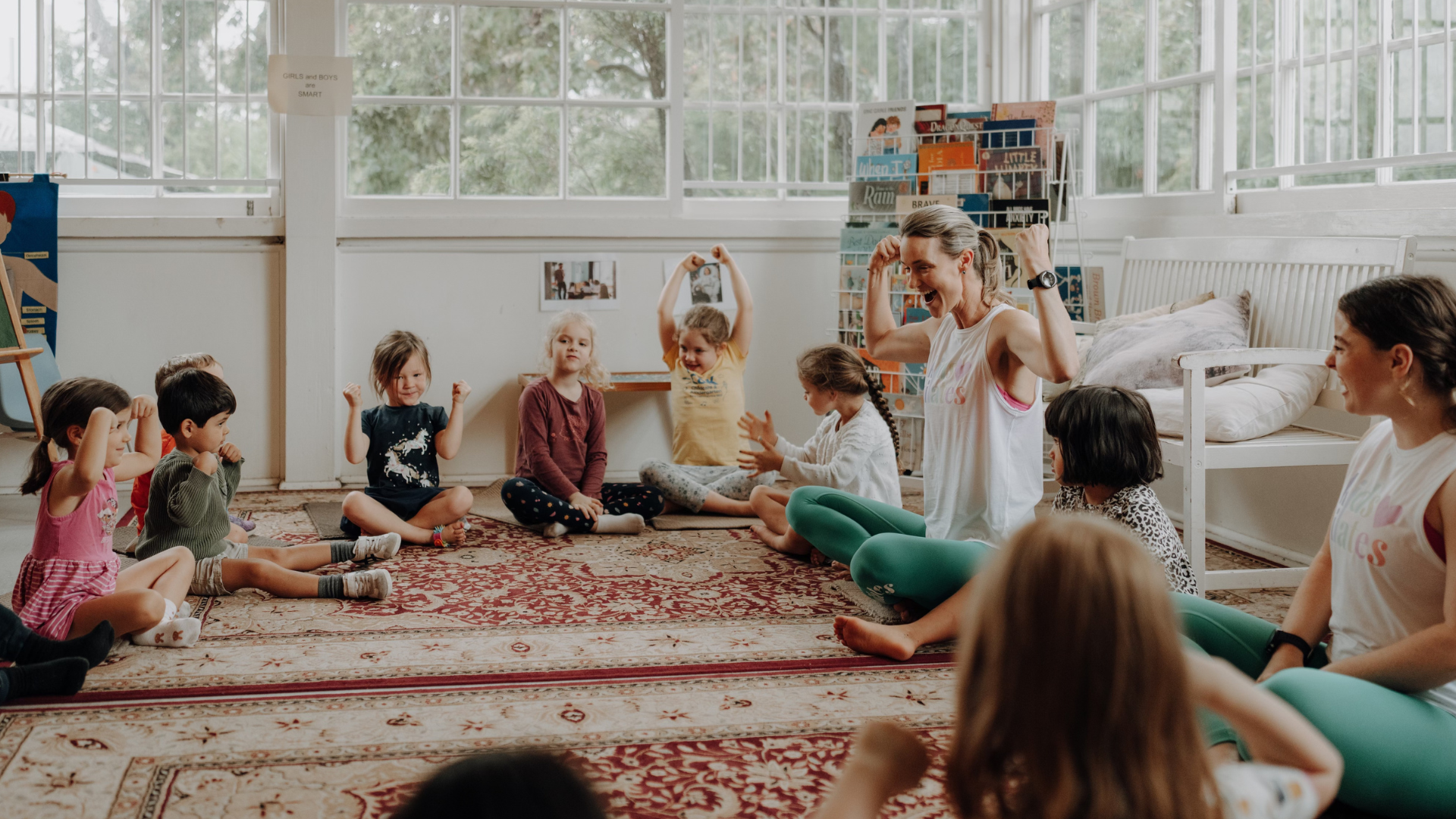
This is something we’re focusing on more within Kids Heart Pilates and our Proactive Kids private programs.
When we assess a child’s movement, we aren’t assessing whether they are a good athlete. We’re looking at the foundations of movement, including:
- balance, hopping, jumping and landing
- throwing and catching
- bilateral coordination
- strength and postural control.
These abilities change considerably throughout childhood. For example, within our paediatric movement assessment, around age five we’re looking for approximately 10 seconds of single-leg balance and around 10 consecutive hops on the dominant foot. By six and seven, we’re looking for increasingly controlled balance, hopping, rhythm and coordination.
Throwing and catching develop too. Younger children may catch using their arms and body before progressing towards more efficient catching with their hands. Throwing progresses from relatively immature patterns towards increasingly coordinated and accurate overarm throwing.
These might look like simple skills, but they’re not just sporting skills. They’re movement foundations.
And one result in isolation doesn’t tell us there is a problem. Children develop at different rates, which is why we look at their movement as a whole rather than deciding a child is “behind” because they can’t perform one particular task.
The good news is that movement skills can be taught
If a child finds movement difficult, we don’t have to simply accept that they’re “not sporty”. Movement skills can improve.
Logan et al. (2012) found that motor skill interventions significantly improved children’s fundamental movement skills. More recently, Yin et al. (2025) conducted a systematic review and meta-analysis of school-based interventions designed to improve fundamental movement skills and also found significant improvements in overall fundamental movement skill competence following intervention.
So there is something we can actually do.
We can assess where a child is at, identify which areas may be making movement harder and then target those areas. That might mean working on strength, balance or coordination, or it might mean actually teaching and practising skills such as throwing, catching, jumping and hopping. Importantly, it also gives children opportunities to experience success in movement.
This is why we’ve developed our private programs
This is really the reason behind our private programs through Kids Heart Pilates and Proactive Kids. We can assess where a child is currently at and identify both the things they’re doing well and the areas that may be making movement harder for them.
Rather than simply saying, “they need to be more active”, we can be much more specific about what that child needs. Maybe balance is difficult. Maybe catching and throwing are challenging. Maybe they need more lower-body strength and power. Or maybe they simply haven’t had enough opportunity to learn and practise particular skills. Whatever it is, we have somewhere to start.
Our goal isn’t to create little athletes or to make every child love sport. It’s to help children become capable, confident movers.
I want kids to have the skills and confidence to join the game at lunch, try a new sport, ride their bike, swim, climb, run around or play with their friends without movement itself being the thing that holds them back.
They don’t have to love sport.
But I want them to have the choice to participate.
So when we’re talking about childhood inactivity, I think we need to look beyond simply asking how we get children to move more. We also need to ask whether they have the skills and confidence to enjoy moving in the first place.
References:
Barnett, L. M., Webster, E. K., Hulteen, R. M., De Meester, A., Valentini, N. C., Lenoir, M., Pesce, C., Getchell, N., Lopes, V. P., Robinson, L. E., Brian, A., & Rodrigues, L. P. (2022). Through the looking glass: A systematic review of longitudinal evidence, providing new insight for motor competence and health. Sports Medicine, 52(4), 875–920. https://doi.org/10.1007/s40279-021-01516-8
Logan, S. W., Robinson, L. E., Wilson, A. E., & Lucas, W. A. (2012). Getting the fundamentals of movement: A meta-analysis of the effectiveness of motor skill interventions in children. Child: Care, Health and Development, 38(3), 305–315. https://doi.org/10.1111/j.1365-2214.2011.01307.x
Robinson, L. E., Stodden, D. F., Barnett, L. M., Lopes, V. P., Logan, S. W., Rodrigues, L. P., & D’Hondt, E. (2015). Motor competence and its effect on positive developmental trajectories of health. Sports Medicine, 45(9), 1273–1284. https://doi.org/10.1007/s40279-015-0351-6
Stodden, D. F., Goodway, J. D., Langendorfer, S. J., Roberton, M. A., Rudisill, M. E., Garcia, C., & Garcia, L. E. (2008). A developmental perspective on the role of motor skill competence in physical activity: An emergent relationship. Quest, 60(2), 290–306. https://doi.org/10.1080/00336297.2008.10483582
Yin, X., Zhang, D., Shen, Y., Wang, Y., Wang, Z., & Liu, Y. (2025). Effectiveness of school-based interventions on fundamental movement skills in children: A systematic review and meta-analysis. BMC Public Health, 25, 1522. https://doi.org/10.1186/s12889-025-22696-2's to help children become capable, confident movers. And when a child feels capable of moving, we give them a much better chance of choosing movement too.
Concerned about your child's movement, coordination or confidence?
Our Kids Heart Pilates program and national program Proactive Kids private provide individual assessment and targeted support to help children build the foundations they need to move, participate and thrive. For Brisbane families, did you know you can book online now? If you are outside of Brisbane fill out our form and we will get in touch.
